The best audio interfaces depend on how you record: a solo vocal or guitar setup needs different connections and controls than a multi-person podcast or live stream. These five MAONO options span compact USB recording, hybrid phone-and-computer workflows, and mixers with dedicated sound pads, so choose around your inputs and recording setup.
Quick Top Products
MAONO PS22 Lite USB Audio Interface
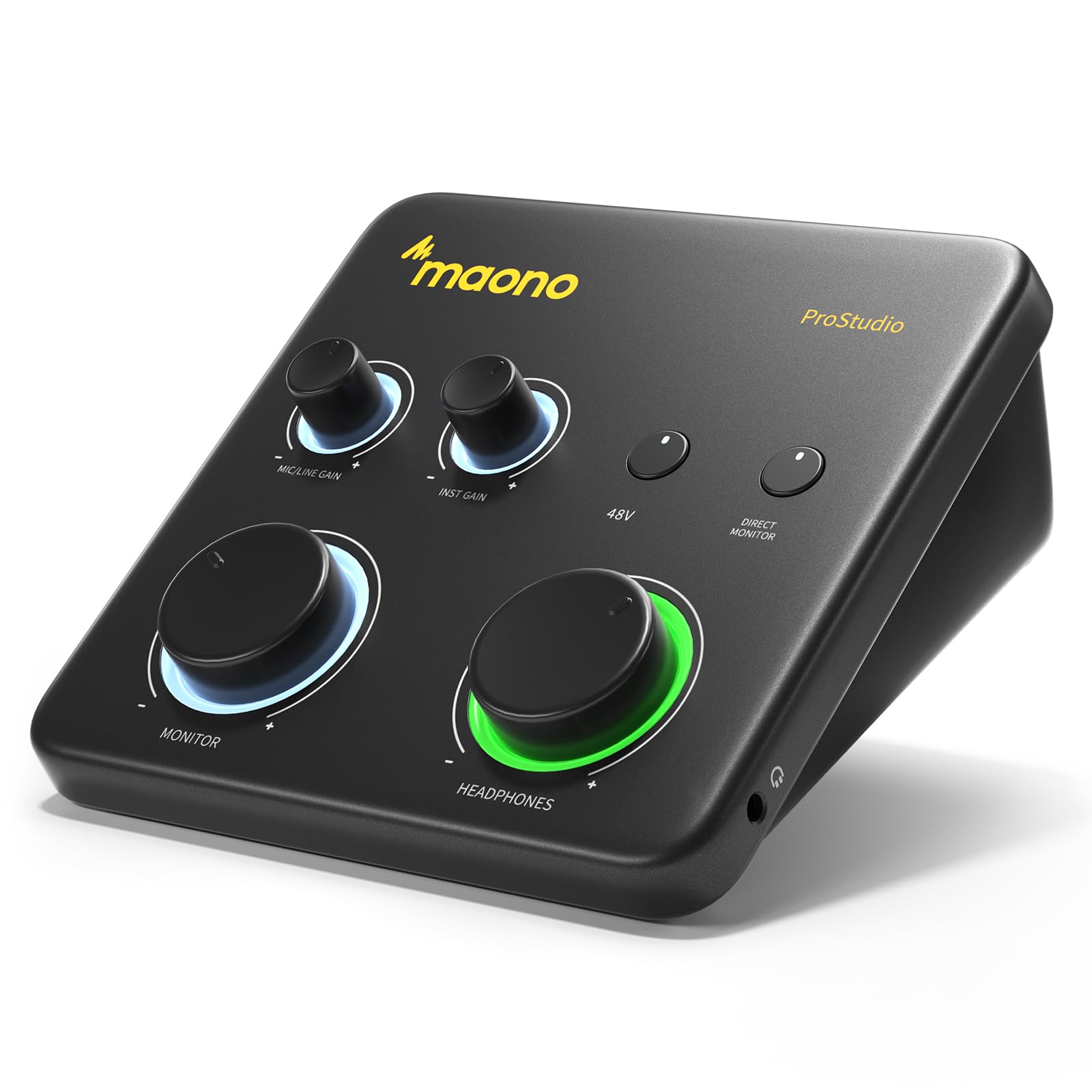
- Records at 24-bit/192kHz and includes a 106dB dynamic range.
- XLR input supports condenser and dynamic mics with up to 56 dB gain and 48V phantom power.
- ProStudio software adds virtual channels and loopback for streaming.
Best For: Solo musicians, podcasters, and beginners who want a compact interface for computer recording.

MAONO P2 Hybrid USB Audio Interface
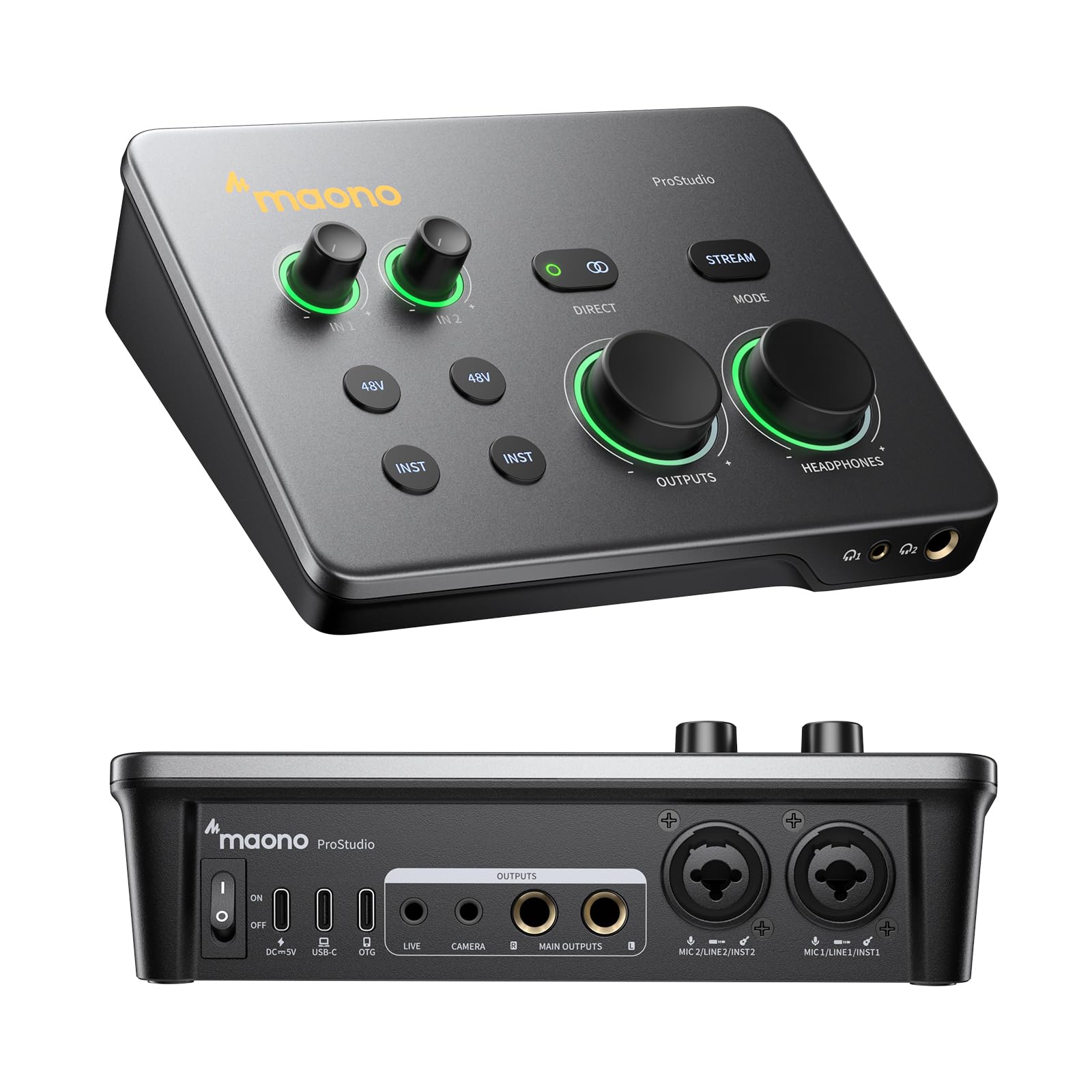
- Dual USB ports connect a computer and phone or iPad simultaneously.
- Dual XLR input supports 24-bit/192kHz recording.
- Built-in loopback and ProStudio 2 support audio routing and effects.
Best For: Creators who record with two microphones and want to connect a computer and phone or iPad at the same time.
MAONO P1 USB Audio Interface
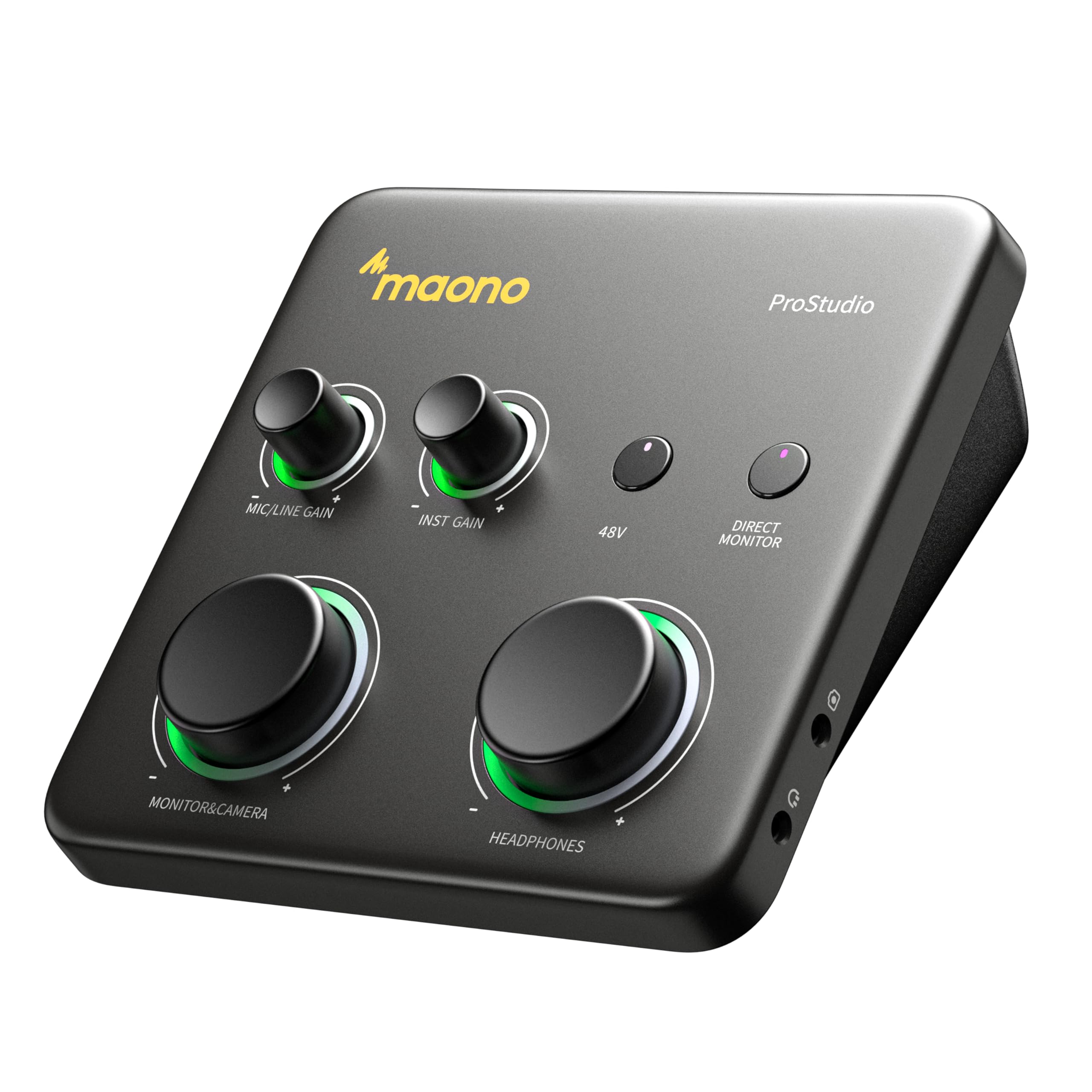
- Provides up to 70dB gain for dynamic microphones.
- Dual USB ports support simultaneous computer and phone or iPad connections.
- Auto-Gain sets a microphone level for voice capture in OBS Studio.
Best For: Solo creators using dynamic microphones who want a compact interface with automatic gain and phone-plus-computer connectivity.
MAONO MaonoCaster AME2 Audio Interface
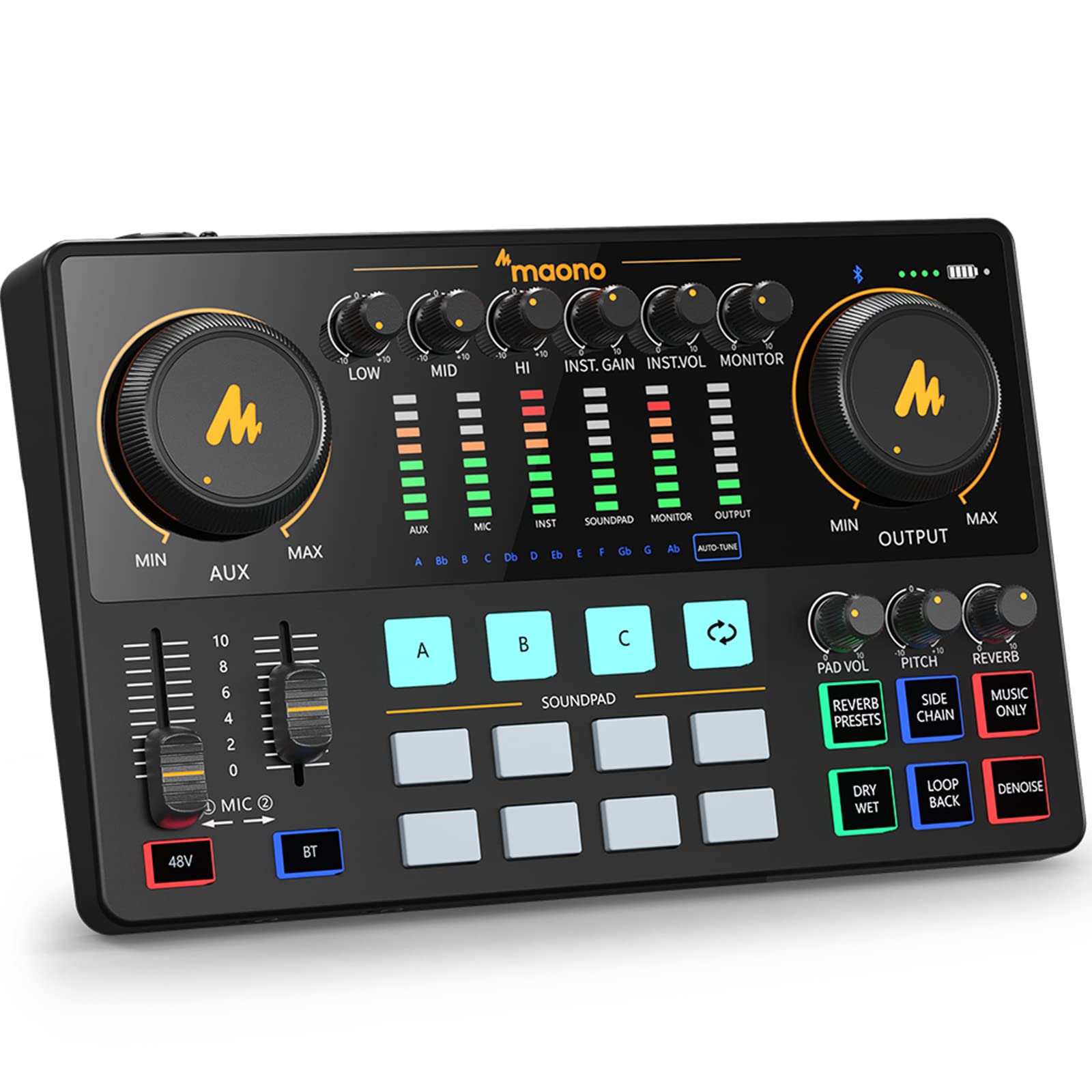
- Includes up to 11 customizable sound pads with looping and adjustable volume.
- Two microphone inputs have independent control, with loopback and sidechain switches.
- The instrument input supports guitar or bass.
Best For: Podcasters and live streamers who want customizable sound pads, mic effects, and instrument input in one mixer.
MAONO MaonoCaster E2 Gen2
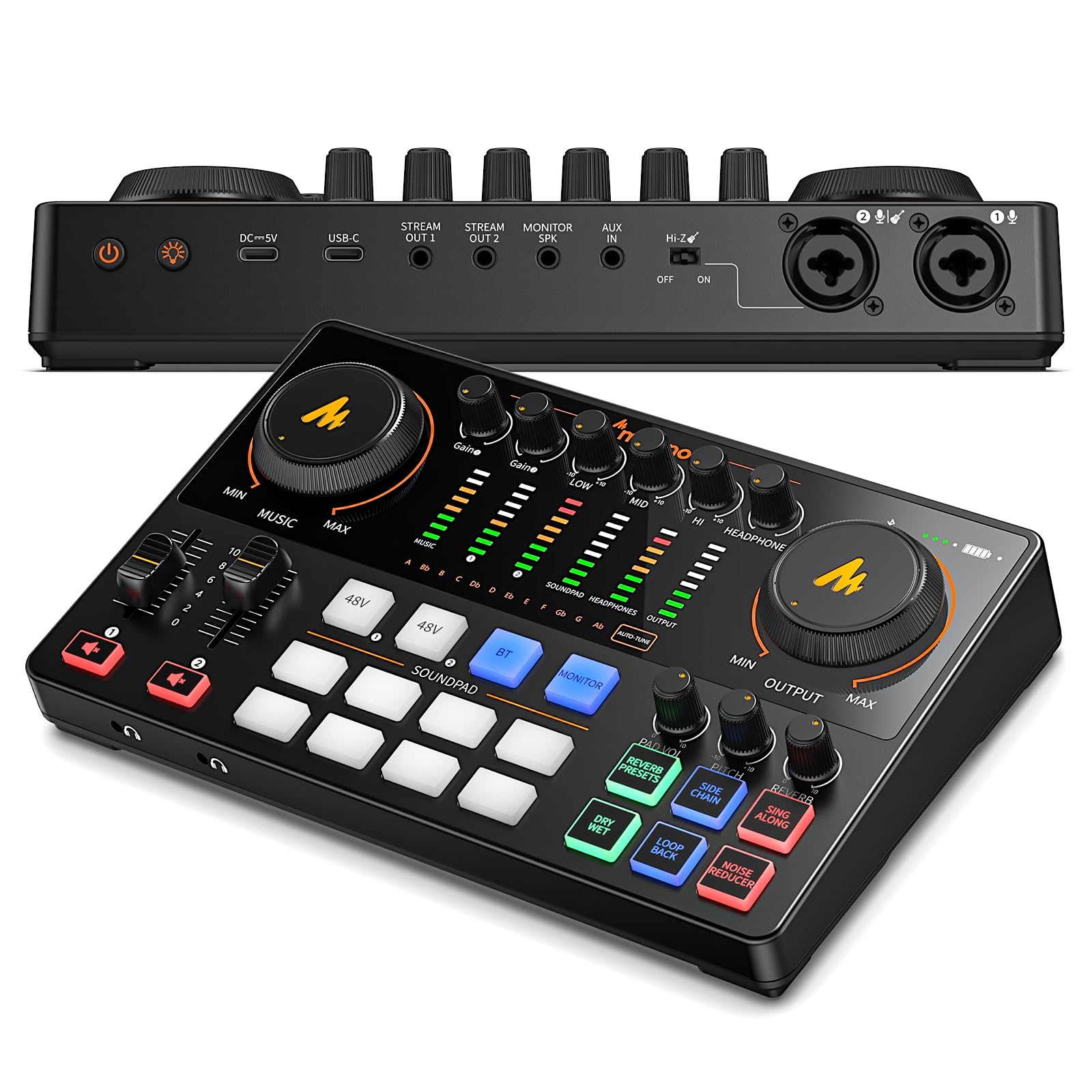
- Two XLR combo inputs and preamps provide up to 60dB gain.
- Eight customizable sound-effect buttons support recordings up to 20 seconds each.
- Built-in 1500mA battery provides up to 8 hours of use.
Best For: Podcast co-hosts and streamers who need two XLR combo inputs, sound effects, and battery-powered operation.
Compact PC and Mac Recording
MAONO PS22 Lite USB Audio Interface for PC: Interface with XLR Input 24-bit/192kHz Routing Software LOOPBACK ASIO Driver for Recording Music, Home-Studio, Guitar, Podcast, Streaming, DAW(Black)
The PS22 Lite is a straightforward choice for recording vocals or guitar to a computer. It supports 24-bit/192kHz recording, has an XLR input with up to 56 dB of preamp gain and 48V phantom power, and includes a dedicated instrument input.
Its ProStudio routing software adds virtual channels and loopback for streaming, while the direct monitoring switch and recording, broadcast, and instrument modes make it approachable for varied tasks. The compact USB design also works with Mac, Windows, and iPads.
Its focus is a small recording interface, so buyers seeking physical sound pads or a multi-mic podcast mixer should look at the larger console-style options.
Best For: Solo musicians, podcasters, and beginners who want a compact interface for computer recording.
| Pros | Cons |
|---|---|
|
|
Choose the PS22 Lite if your setup centers on one microphone or guitar and you want direct monitoring and software loopback in a compact interface. It covers computer recording, streaming, and instrument input without the physical sound-effect controls of the podcast mixers in this group.
Before buying, confirm that its input arrangement fits the number of performers you plan to record; the available details do not specify simultaneous XLR input count.
Dual-Mic Hybrid Creator Setup
MAONO P2 Hybrid USB Audio Interface Dual XLR for PC Phone iPad Guitar
The P2 Hybrid combines dual XLR inputs with two USB ports, allowing a computer and a phone or iPad to connect simultaneously. That setup suits creators who record in GarageBand or Logic Pro and then stream or upload from a mobile device.
It supports 24-bit/192kHz audio, direct monitoring, loopback, and ProStudio 2 routing for bringing desktop audio and effects into a workflow. Independent mute controls and signal indicators help manage recording and streaming from the desk.
The interface also has a 15° tilt and an aluminum-alloy housing. Its listed preamp gain is 56dB, so buyers prioritizing greater specified gain should compare the AME2 closely.
Best For: Creators who record with two microphones and want to connect a computer and phone or iPad at the same time.
| Pros | Cons |
|---|---|
|
|
Pick the P2 Hybrid when connecting a computer and mobile device together is central to your recording or streaming routine. Dual XLR inputs make it a fit for two-mic sessions, and loopback plus ProStudio 2 add routing options for desktop audio.
Its 56dB gain specification is lower than the AME2's up to 60dB figure, while the P2 emphasizes hybrid connections and dual inputs. Check that your phone, cables, and intended app match the simultaneous connection workflow you need.
Higher-Gain Solo Interface
MAONO P1 USB Audio Interface with 70dB Gain for PC, Phone, iPad & Guitar
The MAONO P1 pairs a compact USB-C interface with up to 70dB of gain, which can suit creators using dynamic microphones that need substantial preamp gain. Dual USB ports support simultaneous computer and phone or iPad connections, while Auto-Gain sets a microphone level for voice capture in OBS Studio.
ProStudio2 routing and built-in loopback bring browser, desktop, and instrument audio into streaming or recording workflows. It records at 24-bit/192kHz and includes direct monitoring, independent mute controls, and a 15° tilted layout.
This is a single-interface creator setup rather than a sound-pad mixer; check whether its input configuration meets your microphone count.
Best For: Solo creators using dynamic microphones who want a compact interface with automatic gain and phone-plus-computer connectivity.
| Pros | Cons |
|---|---|
|
|
The P1 is the option to consider when mic gain and assisted voice setup are priorities. Its up to 70dB gain figure and Auto-Gain feature distinguish its workflow, while loopback and dual USB connectivity support mixed desktop and mobile content creation.
The product details do not identify how many XLR microphones can be connected at once, so verify the input layout if you record with a co-host. Also check the power and cable needs for your intended phone setup.
Sound-Pad Podcast Mixer
MAONO Audio Interface, MaonoCaster 10-Channel Podcast mixer with Pro-preamp, 48V Phantom Power, Bluetooth, 11 Customize sound pads for Recording, Streaming, Youtube, TikTok, PC, Guitar (AME2)
The MaonoCaster AME2 is a podcast mixer for creators who want hands-on sound effects and microphone controls. It has up to 11 customizable sound pads, six reverb modes, auto-tune, tone adjustments, and pitch controls, along with loopback and sidechain functions for streaming.
Two microphone inputs are independently controlled, and an instrument input supports guitar or bass. It connects to computers or tablets through USB-C and offers outputs for connecting a smartphone and studio monitor.
The key limitation to plan around is microphone compatibility: it supports analog microphones but not USB microphones. Its bundle centers on podcast and streaming use, with a 10-channel mixer layout and controls for shaping audio.
Best For: Podcasters and live streamers who want customizable sound pads, mic effects, and instrument input in one mixer.
| Pros | Cons |
|---|---|
|
|
Choose the AME2 if you want physical sound pads, voice effects, and hands-on podcast mixing, or if guitar or bass will share the setup. It has controls for live content, but it requires analog microphones because USB mics are unsupported.
Check your existing microphones and cable connections before buying, and consider whether the pads and voice effects are useful to your routine or whether a simpler recording interface better fits your desk.
Two-Host Podcast Mixer
MAONO Podcast Equipment Bundle: Audio Interface mixer with Dual XLR Input for Podcast Streaming - MaonoCaster E2 Gen2
The E2 Gen2 is an all-in-one podcast mixer built around two XLR combo inputs and preamps offering up to 60dB gain. Its eight customizable sound-effect buttons can each hold up to 20 seconds, and the mixer adds one-touch mute, loopback, pitch effects, and six preset reverbs.
USB-C and 3.5mm ports provide connections to phones and computers, with Bluetooth available for background music. A built-in 1500mA battery is specified for up to 8 hours of use, making it useful when a fixed USB connection is inconvenient.
It is tailored to podcast and streaming controls, so music recordists should confirm that its connections and workflow match their DAW setup.
Best For: Podcast co-hosts and streamers who need two XLR combo inputs, sound effects, and battery-powered operation.
| Pros | Cons |
|---|---|
|
|
The E2 Gen2 fits a two-host podcast or stream where two microphone inputs, quick sound effects, and portable battery operation matter. Its eight pads are simpler in count than the AME2's customizable pads, but the included battery adds flexibility for sessions away from a fixed power connection.
Check the 20-second-per-button limit against your audio clips, and confirm how you want to connect instruments or computers for your particular recording software.
How to Choose Audio Interfaces
How We Picked Audio Interfaces
We focused on products that provide a direct path for recording microphones, instruments, or streaming audio. The group includes compact computer interfaces for solo creators, dual-input models for co-hosts, and podcast mixers with physical sound pads and voice effects.
We considered connection flexibility, monitoring, routing features, and the kind of recording each product supports, so the choices serve different creator setups instead of repeating one design.
For a first home recording interface, start with the input you will use most often. A guitar player may want a dedicated instrument input, while a podcast with two speakers needs a clearly specified pair of mic inputs.
If you will use a USB microphone, check support before choosing a mixer; the AME2 explicitly does not support USB microphones.
Comparing Audio Interfaces
The PS22 Lite is the compact recording-focused pick, with XLR and instrument inputs plus software loopback. The P1 and P2 emphasize creator routing and simultaneous mobile/computer connectivity; the P1 specifies up to 70dB gain, while the P2 identifies dual XLR inputs and a 56dB gain specification.
Compare those details against your microphones and whether your workflow requires two mic inputs.
The AME2 and E2 Gen2 are more hands-on podcast mixers. The AME2 adds up to 11 sound pads and several voice controls, while the E2 Gen2 has two XLR combo inputs, eight sound-effect buttons, and a built-in battery.
Their physical controls can suit live shows and co-hosts, while a smaller interface may make more sense for a solo musician who mainly records into a computer.
| Product | Standout features | Best for |
|---|---|---|
| MAONO PS22 Lite USB Audio InterfaceCheck Price |
| Solo musicians, podcasters, and beginners who want a compact interface for computer recording. |
| MAONO P2 Hybrid USB Audio InterfaceCheck Price |
| Creators who record with two microphones and want to connect a computer and phone or iPad at the same time. |
| MAONO P1 USB Audio InterfaceCheck Price |
| Solo creators using dynamic microphones who want a compact interface with automatic gain and phone-plus-computer connectivity. |
| MAONO MaonoCaster AME2 Audio InterfaceCheck Price |
| Podcasters and live streamers who want customizable sound pads, mic effects, and instrument input in one mixer. |
| MAONO MaonoCaster E2 Gen2Check Price |
| Podcast co-hosts and streamers who need two XLR combo inputs, sound effects, and battery-powered operation. |
Connections, Inputs, and Microphone Gain
Count the microphones and instruments you need to connect at the same time. The PS22 Lite describes an XLR input and a dedicated instrument input; the P2 and E2 Gen2 specify dual XLR connections, and the AME2 offers two independently controlled mic inputs plus guitar or bass input.
The P1 highlights up to 70dB gain, while the other interfaces specify different preamp capabilities. Match gain and input type to your microphone rather than assuming every XLR interface will suit every mic equally.
Also check how devices connect. The P2 and P1 describe dual USB ports for a computer and phone or tablet together.
The AME2 uses USB-C for a computer or tablet and separate live outputs for a smartphone, while the E2 Gen2 includes USB-C and 3.5mm connections. Compatibility depends on your actual device, cable, and recording app, so confirm the intended connection path before purchase.
Routing and Monitoring for Streaming
Loopback can combine microphone, instrument, and computer audio for a stream or recording. The PS22 Lite includes ProStudio routing with virtual channels, while the P1, P2, AME2, and E2 Gen2 also describe loopback features.
The P1 and P2 add ProStudio software routing; the AME2 and E2 Gen2 provide physical mixer controls aimed at live content. Think through whether you prefer managing audio in software or changing levels and effects directly on the device.
Direct monitoring helps you hear a mic or instrument while recording. The PS22 Lite, P1, and P2 specify direct monitoring, and the P2 mentions independent headphone and monitor controls.
If you stream live, consider mute access and input-level feedback too: the P1 and P2 provide independent mute controls and indicators, while both podcast mixers include one-touch or dedicated controls for shaping a show.
Who Should Buy What for Audio Recording
Choose the PS22 Lite for compact computer recording with guitar input and software loopback. The P1 suits a solo creator who wants its higher specified gain and Auto-Gain voice setup.
Pick the P2 when two XLR inputs and a simultaneous phone-and-computer workflow matter. For sound pads and microphone effects, consider the AME2; for a two-host podcast with battery-powered operation, the E2 Gen2 is the more targeted fit.
Before deciding, make a short list of your microphones, instruments, devices, and software. Confirm the number and type of inputs, the cable connections required, and whether you prefer physical mixer controls or software routing.
That checklist narrows the choice to an audio interface that fits how you actually record and stream.